LG Washer OE Code: What It Means and the 4 Checks LG Lists
LG washer OE code means the washer cannot drain. The four owner checks on LG's own support page, in LG's order, and where LG says to request service.
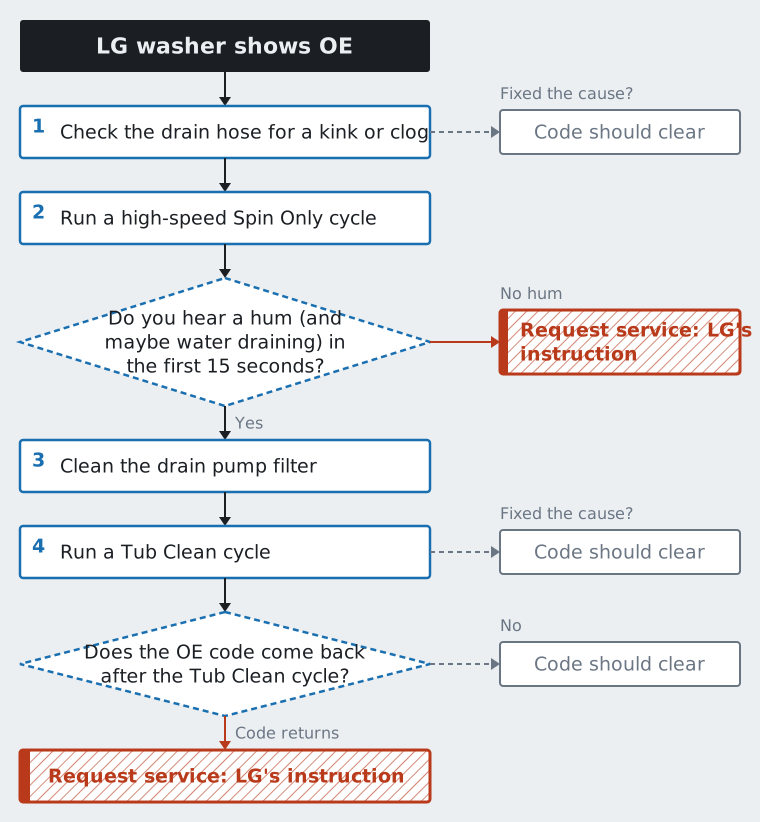
LG washer OE code means one thing, and LG's own support page says it in one sentence: the washer can't drain the water from the wash cycle. The two causes LG names are a kinked drain hose and a clogged drain pump filter. Everything below is that page, restated in LG's order, with the point where LG stops and says to request service marked exactly where LG puts it.
LG washer OE code in one line, then the checks
If you only read one paragraph: OE is a drain fault. LG lists four owner checks, in this order: look at the drain hose, run a high-speed Spin Only cycle and listen, clean the drain pump filter, run a Tub Clean cycle. Two observations decide whether you continue or stop. If there is no humming sound during the spin test, LG says the drain pump is not working and the washer needs service. If the code comes back after the Tub Clean cycle, LG says the unit may need service. That is the whole decision tree, and it is drawn at the top of this page from the site's record of LG's page.
The source is LG's page "LG Washer - What is a Front Load Washing Machine OE Error Code?", which LG shows as last updated 09/03/2026. It was read on 2026-10-16. Nothing in this guide comes from a forum, a repair blog or a service manual, and nothing has been added to LG's list.
| LG's step | What you do | What decides the next step |
|---|---|---|
| 1. Check for a kinked drain hose | Look behind the washer for a kink or a clog; fix it and run a spin cycle | If the code is gone, you are done |
| 2. Test the drain pump | Run a high-speed Spin Only cycle | Go to step 3 |
| 3. Listen for a humming sound | In the first 15 seconds, listen for a hum and possibly draining water | Hum: go to step 4. No hum: LG says request a repair |
| 4. Clean the drain pump filter | Unplug the washer, open the bottom-left panel, drain the hose, unscrew and clean the filter | Go to step 5 |
| 5. Run a Tub Clean cycle | If you removed debris, run Tub Clean and watch for the code; if the filter was clean, run Tub Clean, use less detergent, run a normal cycle | Code gone: done. Code returns: LG says the unit may need service |
| 6. Request a repair | Contact LG support | Technician only beyond here |
The rest of this guide walks through each step with LG's own detail, explains why the order matters, and draws the boundary this site keeps on every page.
What LG's page says OE means
LG's wording is short. An OE error code means the washer can't drain the water from the wash cycle. The common causes are a kinked drain hose or a clogged drain pump filter.
Two things are worth noticing in that sentence. First, LG does not call OE a pump failure. It calls it a drain failure, and it lists the pump filter, not the pump, as a common cause. Second, LG lists the hose first. A hose can be kinked by the washer being pushed back against a wall, by a laundry basket wedged behind it, or by the hose having been bent during installation. It costs nothing to look, which is why LG puts it at the top.
This is a different fault from the LG UE code, which is about load balance rather than drainage. The two are covered on separate pages because LG treats them separately, and the checks do not overlap.
Step 1: check the drain hose
LG's first instruction is to check for a kinked drain hose. Look behind the washer for kinks or clogs. If you clear a clog or straighten a kink, LG says to run a spin cycle to see whether the error is resolved.
This step involves no tools and nothing inside the machine. If the hose was the cause, the spin cycle drains, the code does not reappear, and you stop here. If the hose looks fine, or the code returns after a spin, move to step 2.
Step 2: run a high-speed Spin Only cycle
LG's second step is a test, not a fix. Turn the washer on, select the Spin Only cycle, set the spin speed to high, and press Start/Pause. LG uses this cycle to test the drain pump, because a spin cycle starts by pumping out whatever water is in the drum.
Nothing else is needed. The washer can be empty or have the wet load still in it. What matters is what you hear in the first fifteen seconds, which is step 3.
Step 3: listen for a humming sound
This is the step that decides where you go next, and it is the only observation LG asks for in the whole sequence. During the Spin Only test, LG says you should hear a hum, and possibly draining water, for the first 15 seconds.
If you hear the hum, the drain pump is running. LG sends you to step 4, cleaning the drain pump filter, because a running pump that cannot move water is most likely blocked at the filter.
If you do not hear the hum, LG's page is direct: the drain pump isn't working and the unit needs service. That is the end of the owner checks for a silent pump. The decision tree at the top of this page shows that branch leaving the main column and ending in the red request-service box. There is no step on LG's page, and no step on this site, that describes what to do with a pump that does not run.
Step 4: clean the drain pump filter
For a pump that hums, LG's fourth step is the one most people remember. Here is LG's sequence, in order:
- Turn off the washer and unplug it. LG lists this first, before the panel is opened.
- Open the service panel in the bottom-left corner of the washer's front.
- Unclip the short drain hose and remove its cap to drain the leftover water into a shallow pan. LG warns not to pull the hose out too far, because that can kink it; if nothing drains, push it back in about an inch.
- Unscrew the pump filter counter-clockwise. Do it over a towel, because water comes out with it.
- Clean the filter with a soft brush and warm water. LG says not to put it in a dishwasher.
- Brush out the filter opening and its base.
- Put the cap back on the short hose and reattach it.
- Reinsert the filter, tighten it clockwise until it stops, and close the cover.
Everything in that list is owner-accessible by LG's own description: a panel designed to be opened, a hose designed to be unclipped, a filter designed to be unscrewed. No wiring is touched, no fastener is removed, nothing is energised. The washer is unplugged for the whole step. That is why it sits in blue on the decision tree.
What you find in the filter tells you something. Coins, hair ties, a sock, lint felt: that is debris, and LG's next step assumes you removed it. A clean filter is also an answer, and LG's page handles that case separately in step 5.
Step 5: run a Tub Clean cycle
LG's fifth step splits on what you found at the filter.
If you removed debris, run a Tub Clean cycle and see whether the OE code clears. A blocked filter that is now clear should let the pump drain normally, and the Tub Clean cycle is a full fill-and-drain that proves it.
If the filter was already clear, LG offers a second explanation: excess suds may have caused air pockets that the pump can't drain. In that case LG says to run a Tub Clean cycle, use less detergent, then run a normal cycle. Too much detergent, or detergent that is not high-efficiency, foams in a front-load drum, and a pump pulling foam instead of water can trip a drain timeout.
Then the second decision. If the OE code returns after the Tub Clean cycle, LG's page says the unit may need service. That is where the main column of the decision tree ends in red.
Step 6: request a repair, and why the guide stops here
LG's page has two routes into a repair request: no hum in step 3, or the code returning in step 5. For both, LG directs owners to request service through its support channels. This site repeats that instruction and adds nothing after it.
The parts past the filter are the drain pump itself, its wiring and connector, the pressure sensor that tells the control board the drum is empty, and the internal hoses between the drum and the pump. LG's owner page does not describe any of them. This site does not either, and that is a rule rather than an omission. The research that led to this site set a kill condition: no diagnostic content that goes past what a manufacturer publishes for owners, and never a walkthrough involving gas, live electrical work or refrigerant. When to stop and call a technician explains the rule across all eight codes on the site.
Why LG's order is the right order
It is tempting to go straight to the filter, because it is the step that feels like a repair. LG's order is better for three reasons.
The hose check is free. It takes a minute, needs no tools, and if the hose is the cause you never open the panel at all.
The spin test tells you whether the filter step can help. A filter clean cannot fix a pump that does not run. Doing the sound test first means that a silent pump goes to a repair request straight away, instead of after half an hour on the floor with a towel.
The Tub Clean step closes the loop. It is the only way LG gives you to prove the drain is fixed, and it is the step that catches the detergent case a filter clean misses.
The decision tree keeps this order because LG's page keeps it. Every box on the tree is one of LG's steps, every diamond is one of LG's two observations, and the red boxes are LG's two repair instructions.
OE on other brands, and other LG codes
The letters OE are specific to LG among the brands verified on this site. On the official Samsung, Whirlpool and Bosch pages read on 2026-10-16, no code is written OE. If a Samsung, Whirlpool or Bosch display shows something that looks like it, do not apply LG's checks; use that brand's own page.
The same symptom, a washer or dishwasher that will not drain, does appear on other brands under other codes, and the checks are not identical. Whirlpool's F9 E1 is a long-drain code whose owner checks are about hose depth in the standpipe, an air gap, the pump filter on some models and the door seal. Bosch's dishwasher E24 is a drain code whose checks include a loose pump cover and a garbage-disposal knockout plug. Each is on its own page, with its own manufacturer's order, reachable from the code lookup.
| Code | Brand and appliance | Meaning per the manufacturer | Owner checks listed |
|---|---|---|---|
| OE | LG front-load washer | Cannot drain the water from the wash cycle | 4 |
| F9 E1 | Whirlpool front-load washer | Long drain time; unable to drain correctly | 4 |
| E24 | Bosch dishwasher | Not draining properly; drain filter blocked | 5 |
| UE | LG top-load washer | Could not balance the load for spin | 4 |
The counts in the table are from the site's own records, which hold only what each official page listed.
What to have ready if you call LG
If the spin test was silent or the code came back after Tub Clean, LG's instruction is to request a repair. Three things make that call shorter:
- The code exactly as the display shows it. LG uses uppercase OE for this fault; other LG codes use mixed case, and the difference matters.
- The model number from the rating plate, which on LG front-load washers is usually inside the door rim or on the back.
- Which of LG's steps you did and what happened: whether the hose was kinked, whether the pump hummed, what was in the filter, and whether Tub Clean cleared the code. That is the sequence LG's own page follows, so it is the sequence support will ask about.
Sources
- LG Electronics, "LG Washer - What is a Front Load Washing Machine OE Error Code?", last updated 09/03/2026, read 2026-10-16: lg.com
- LG Electronics, "LG Washer - What is a Top Load Washing Machine UE/Ub Error Code?", last updated 09/03/2026, read 2026-10-16, used only for the comparison row: lg.com
- This site's record for the code, with the retrieval date and review status: /codes/lg/washer/oe/
An LG washer OE code is a drain fault with four owner checks and two clear exits to a repair request; follow LG's order, stop where LG stops, and the lg washer oe code either clears at the hose, the filter or the detergent, or it becomes a technician's job.
Frequently asked questions
What does the OE code on an LG washer mean?
LG's front-load support page says OE means the washer can't drain the water from the wash cycle. LG names a kinked drain hose or a clogged drain pump filter as the common causes.
Can I fix an LG OE code myself?
LG lists four owner checks: straighten or unclog the drain hose, run a high-speed Spin Only cycle and listen for a hum, clean the drain pump filter with the washer unplugged, and run a Tub Clean cycle. If there is no hum during the spin test, or the code returns after Tub Clean, LG says the washer needs service.
Where is the drain pump filter on an LG front-load washer?
LG's page says it is behind the small service panel in the bottom-left corner of the front of the washer. You unplug the washer, open the panel, drain the short hose into a shallow pan, then unscrew the filter counter-clockwise over a towel.
Why does LG say to listen for a humming sound?
LG uses the sound as the deciding test. During the first 15 seconds of a high-speed Spin Only cycle you should hear the drain pump hum and possibly water draining. If you hear it, LG sends you to clean the filter. If you do not, LG says the drain pump is not working and the unit needs service.
Is the LG OE code the same on top-load washers?
LG publishes a separate OE page for top-load washers. This guide follows the front-load page only, because that is the one read and recorded. Use the lookup tool or LG's own site for the top-load version rather than assuming the checks are identical.
Should I use less detergent after an OE code?
LG's page says that if the drain pump filter was already clean, excess suds may have created air pockets the pump cannot drain. In that case LG says to run a Tub Clean cycle, use less detergent, and then run a normal cycle.